Wednesday, November 19, 2008

Hello Mr. Jackman

It seems everyone is under Baz Luhrman's spell waiting in eager anticipation for Australia. And People Magazine, it seems, is smart enough to realize it. People's Sexiest Man Alive 2008? None other than the leading man of Australia, perhaps both the movie and the country, Hugh Jackman.

Hugh Jackman at People.com

Alas, the man is getting the recognition I've felt he's deserved for years. Sexiness aside, though I'm not one to pretend that I have not fallen under Mr. Jackman's spell, his acting, singing, and dancing chops deserve much recognition. Having only really come into view in 2000's X-Men as Wolverine, Jackman has proceeded to have a surprisingly well-rounded career in the past eight years. From Wolverine, Leopold in Kate & Leopold, the legendary Van Helsing, to his turn as Robert Angier in The Prestige, and the voice of Memphis in Happy Feet, Jackman has covered quite the spectrum.
Lest we forget, Hugh Jackman also won the 2004 Tony Award for Best Actor in A Musical, portraying fellow Aussie, songwriter Peter Allen in The Boy from Oz. You can read about some of Jackman's thoughts on the experience in this CBS article.

Those who would like to still further wet their appetite for the talented Mr. Jackman can watch him sing, dance, and melt the hearts of women as Curly in a stage production of Oklahoma! and here acting as the aforementioned Peter Allen at the '04 Tony Awards--and yes, that is Sarah Jessica Parker.
Just something to think about as you watch Luhrman's soon to be released Australia. And for the doubters that he should be People's Sexiest Man Alive, well, perhaps I can't convince you otherwise, but at least recognize his talent. This Aussie is certainly doing his country proud.

(Images thanks to: http://www.sydentcent.com.au/index.cfm?s=content&p=event_detail&event_id=101937
and http://seat42f.com/site/index.php?option=com_content&task=view&id=3192&Itemid=299)

Tuesday, November 18, 2008

BBC: Australia hopes Luhrmann's film boosts tourism


They're hoping for another Crocodile Dundee, apparently. I will be seeing this three-hour long film on Thursday afternoon.

Wednesday, November 12, 2008

Second Essay


For those of you who want to start thinking of topics for your second essay (due December 4th), here are some guidelines.

The essay will be slightly longer than your first one: between 1800-2000 words (6-7 pages). You'll follow the same MLA format for citations. You are expected to use at least three exterior sources, and one of these should be your text Australian Cinema in the 1990s. Don't choose a topic that merely mirrors the chapter headings or main points (i.e. "disability in Sweetie")--instead try to use the readings and class discussions as a guideline to create a topic based on your own unique interests and concerns.

Your topic focus should be on films we have viewed in the second half of class so far, starting with Jane Campion's Sweetie. It is recommended you write about one of the films viewed in class, however, if you want to write about another film by one of the filmmakers we've studied, for example Jane Campion or Peter Jackson, this is permissible. If you want to write about a filmmaker we have not studied closely in class, for example Gillian Armstrong (who directed My Brilliant Career and Last Days of Chez Nous) or Baz Luhrmann, you may, but you need to get your topic approved by me first. It makes sense to focus on Australian films by Australian directors, but if you'd like to go outside of this guideline, again, give me a heads up. I would prefer that your essays focus on ONE film, not a survey of an entire career or ouevre.

I highly recommend that you all submit an abstract for your essay via email before you start working, to make sure your topic is on track. The abstract should be a paragraph in length and should clearly state your topic, in the form of a thesis statement and mentioning your main line/s of inquiry. The abstract can substitute for your first paragraph of your essay and you should aim to have the abstract contain the same kind of information you'd include in an opening paragraph.

Morbid Fascination


OK... I am happy to report that I am not the only one struck with a morbid fascination since seeing the film, Heavenly Creatures. Maybe its the abnormal psychology thing or simply the viciousness/apparent premeditation of the attack. I do know that the film captured my interest, or was it the story itself?

After researching, I was astonished to find that Juliet Hulme is now Anne Perry, a crime novelist with an impressive fan base. It seems amazing to me that her readers seem to draw no sense of irony related to her true identity. Maybe many are unaware of her true identity, though there is plenty of information available. Perry has been somewhat tight-lipped (as you can imagine) about this episode in her early life. But there is a very interesting interview she granted to Ian Rankin in which she discusses redemption and responsibility. However, she also refers to herself as an 'accessory' to the murder and claims that Pauline threatened to kill herself if they did not kill Pauline's mother, the 'obstacle' to their remaining together. In the past, she has also alluded to her TB medications causing her mental incapacitation at the time. Perry also refutes that her relationship with Pauline was homosexual in nature. She is a devout Mormon and seems to have come to some kind of peace with herself and her past. She resides in Scotland.

Pauline's life after prison has not been as glamorous, though decidedly successful considering that she was convicted of murdering her mother. She went on to study and teach, acquiring the post of headmistress before retiring. She managed to maintain her anonymity a bit longer than Juliet. She took the name Hilary Nathan and now owns and operates a riding school in rural England. She is considered a devout Roman Catholic and our only real understanding of her inner life comes from a brief explanation by her sister, Wendy, that she is fully remorseful for the murder.

Neither Pauline nor Juliet ever married. Juliet classifies herself as heterosexual and there a bit of evidence that Pauline is homosexual. I do find it interesting that Juliet claims that there was no homosexuality involved. No matter the physical relationship the girls had, without benefit of the film and only when reading the diary passages and trial testimony, it is clear that the relationship was an explosively charged and intense one. Though the insanity defense did not stick, the defense psychologist explains that the girls were suffering from a folie a deux, or 'communicative insanity'. This disorder is generally characterized by one dominant ego and another receptive ego. What may have been a more accurate diagnosis is folie simultanée, where two equal egos influence each other in shared delusions. What is most amazing is that these women have been to a precipice of madness and it seems that each were able to pull back from that step, in deed, anyway. There is no way that we will ever know the truth about the girls, their mental states and, ultimately, who they were and why they murdered Nora. The story's unfolding in Heavenly Creatures does show us a vivid, rich possibility. In the end, though, its just a movie and the truth of it all will never be truly understood.

Queer Mateship


Muriel's Wedding has been a favorite film for years. I own it and every once in a while pop it in for a good laugh/cry. In the context of this class, I have been able to appreciate it in a new way. Related to this film, I better understand that oh-so-macho concept of mateship.

Muriel's Wedding is, first and foremost, offering biting social commentary about machismo. It turns on its head the concept of mateship that we've been discussing by exploring the same bond between women who ultimately choose to live life together, and without husbands. Although not surprising or controversial, I found the classroom discussion regarding homoerotic tensions in the film interesting. Before this discussion, it would never have occurred to me that Rhonda and Muriel's relationship is homosexual in nature. However, in the narrative as presented I can certainly see how and why the relationship is easily seen as homosexual, even if not in action but spirit alone. There is a sense of dramatic camp to the film (which is closely tied to queer expression.) Greg Taylor is quoted: http://salymanderfilmaslit.blogspot.com/2007/01/camp-campy-campiness.html "camp is fundamentally an aesthetic declaration of the spectator’s ability to choose and manipulate the cultural meaning surrounding her. Camp has been appealing to dominated cultures […] precisely because it asserts control over one’s own symbolic identity." ABBA has long been described as campy, and Hogan's use of their music must have been fertile soil to create the story.

So, what is it that the film critiques? I think it is the very essence of mateship as an understood extension of the concept of 'a man's country'. By deconstructing the patriarchal figure-head of the Helsop family and reconstructing mateship in the context of female relationship, Hogan takes a postmodern swipe at the heart of what can be seen as misogynistic national ideals. And what better choice than a campy production fueled by camp music to make his point. Essentially, this is what camp has attempted to illuminate (Sorry Susan Sontag, I do take some exception to your thesis.)

I suppose, in the end, I do not think that the movie is homosexual, necessarily. I do believe that it is an example of queer expression, which has grown to illustrate and give voice to heterosexual lifestyles operating outside of and rejecting the artifice of the 'norm'.

Sunday, November 9, 2008

Australian Films on IFC!


There are a number of Aussie films being shown on IFC (the Independent Film Channel) this weekend. Yesterday they showed Picnic at Hanging Rock (which I wanted to watch but my husband's eyes started to glaze over). This afternoon they showed The Cars That Ate Paris (damn I missed it!) and right now they are showing Proof, and tonight at 11:05 pm is Lantana, starring Anthony LaPaglia, Geoffrey Rush and Barbara Hershey. Some of these films are repeating later this month.

Friday, November 7, 2008

Australian Cinema Today

So this far in the class we have watched several of Australia's finest movies from the seventies, eighties and nineties - many of the films which defined Australia's cinema and exposed cultural themes found in no other country.

But what of Australian cinema today?

I'm sure many of us have heard about or even seen the preview of the soon to be released 'Australia', starring both Nicole Kidman and Hugh Jackman. The film is directed by Baz Luhrmann of 'Moulin Rouge', 'Romeo + Juliet' and 'Strictly Ballroom' fame - all Australian influenced films which have achieved mainstream success in America. 'Australia' seems to fit the exact same profile as Luhrmann's previous films: it stars Australian born but mainstream Hollywood actors, it is produced by American Hollywood studios and appears to be targeted at American movie goers.

I refuse to believe that 'Australia' will do the nation's cinema much justice; so I set out and searched the internet to see what critically acclaimed yet non-mainstream Australian films have been produced in the last two years. And here are my findings:

The Black Balloon (2008)


Starring 'Muriel's Wedding''s own Toni Collette, 'The Black Balloon' was released just this year and filmed entirely in New South Whales, Australia. It is about a boy trying find a normal adolascence and come to accept his autistic brother. The film received two notable Australian awards and was well regarded by audiences and critics alike.
The Black Balloon

The Jammed (2007)


'The Jammed' is a low budget but multiple award winning independent film that was entirely filmed in Australia. The story follows the lives of a handful of women and their struggle with sex trafficking and deportation in the city of Melbourne. The film was acclaimed for its realism and award winning script.
The Jammed

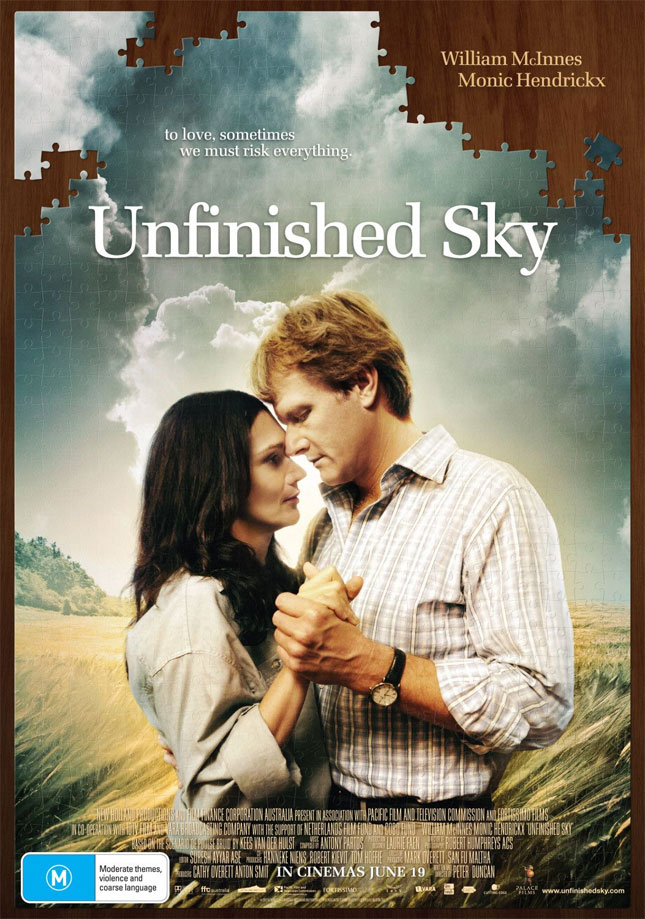
The Unfinished Sky
(2007)


Australian Director Peter Duncan tells the story of an outback farmer who takes in an Afghani woman who has fled from a local brothel. The entirely Australian funded film was nominated for nine awards and praised for its stunning cinematography and portrayal of the outback around Queensland, Australia.